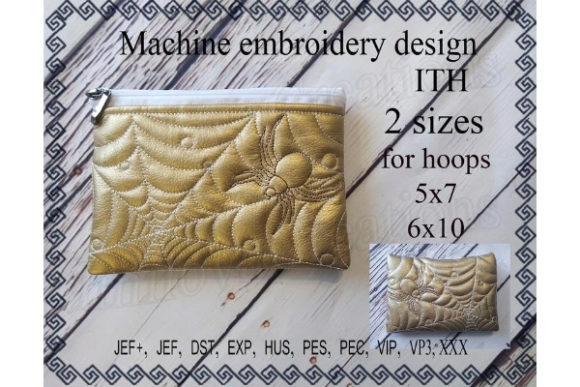
A Spider Design for Your Cosmetic Bag Embroidery Project
When you're looking at a new embroidery design for real project use, the first question isn't just "Is it cute?" It's "Where will this actually work, and what will it feel like when stitched out?" That's the lens I'm using as I evaluate the Cosmetic Bag – Spider design. This isn't about abstract appreciation; it's about imagining the needle hitting the fabric and the finished product in someone's hands.
The First Impression: Spooky Charm, Not Scary
The immediate mood here is playful spookiness. It's the kind of embroidery design that leans into a theme without being overly dramatic. The spider motif suggests it belongs naturally on items for a certain aesthetic—perhaps for someone who loves Halloween year-round, or just has a taste for quirky, nature-inspired details. The layout feels centered and balanced, which is a huge plus for applying it to a predefined space like a cosmetic bag or a tote panel. The detail level appears thoughtful; it's not an overly dense scientific illustration, but a stylized, approachable character. This visual personality means it could transition well from a personal handmade product to a small shop product without seeming too niche or too generic.
Where This Spider Finds Its Perfect Home
Let's talk real-life application. I'm picturing a specific scenario: a client requests a custom, slightly quirky gift for a friend who loves arachnids. I'd consider this Cosmetic Bag – Spider design immediately. Its "cute" descriptor in the brief is accurate—it avoids the creepy factor, making it suitable for a wider audience than just hardcore Halloween fans.
For custom apparel, a sweatshirt or t-shirt would be a prime candidate. The design's likely scale means it would sit nicely on a chest or sleeve without dominating the garment. On a tote bag, it becomes a statement piece, elevating a simple bag into a themed accessory. For baby clothes or nursery decor, I'd be more cautious—the theme might not be universally appealing for babies, but for the right family with a specific style, it could work on a knit blanket or a wall hoop. Its charm makes it a contender for holiday embroidery projects, obviously for Halloween, but also as a unique alternative to typical holiday motifs.
As a embroidered patch, it would be fantastic. The clear shape and likely defined outlines would translate well into a satin stitch border, making it a great iron-on or sew-on patch for backpacks or jackets. For small business merchandise, say for an Etsy seller specializing in alternative gifts or nature-themed goods, this design adds a ready-made, professional-looking asset to their lineup. It could be the focal point on a pillow cover or a tea towel for a boutique kitchen line with a dark academia vibe. The key is that it carries a personality, which helps in buyer engagement—it tells a story on the product.
Caution Areas: Fabric and Finishing Considerations
No design is universally perfect, and practical judgment means spotting where extra care is needed. For the Cosmetic Bag – Spider, I'd pay close attention to application on certain materials.
- Stretchy fabric like thin t-shirt jersey could be tricky if the design has high stitch density. Without proper stabilizer, the pull could distort those finer lines.
- Dark fabric demands a smart thread color choice. A black spider on a black bag might vanish; you'd need to test a high-contrast color scheme.
- Curved surfaces like caps require checking the design's dimensions. A large, wide design might not fit the curved crown area smoothly.
- If the design incorporates tiny details, like fine legs or small accent dots, they might get lost on highly textured fabrics like boucle knits or linen.
- For products needing frequent washing, like kitchen towels, ensuring the stitches are secure and using durable thread is paramount.
These aren't flaws of the design; they're just the reality of machine embroidery. Knowing them upfront saves time and materials.
The Professional Impact: From Stitch to Sale
When you use a design like this for client work or your craft business, its execution directly affects perceived value. A clean stitch-out of this spider, with good contrast and no puckering, immediately boosts customer trust and the handmade presentation. It looks intentional and skilled, not haphazard. For brand consistency, if your shop has a quirky, nature-themed aesthetic, this design fits like a puzzle piece, strengthening your visual identity.
Its giftability is high for the right recipient—it feels personalized even if it's a standard embroidery file. For commercial embroidery projects, like producing a batch for a local boutique, its clear theme makes it an easy sell. It also lends itself well to printable mockups for your digital storefront, showing potential buyers exactly how it could look on a bag or apparel.
A Designer's Essential Pre-Stitch Checklist
Before I'd ever load this digital embroidery file for a real project, here’s my routine:
- Test on scrap fabric first. Always. Use the same material you intend for the final product.
- Check thread color contrast against your final fabric background. Do a quick mental swap: how would it look on light vs. dark?
- Review stitch density by looking at the preview in your software. Are there extremely dense fill areas that might require a change in needle or stabilizer?
- Confirm hoop size compatibility. The design description mentions it's for a cosmetic bag, which implies a certain scale. Make sure it fits your intended hoop without needing excessive resizing, which can distort stitch quality.
- Inspect small details. Zoom in on the file preview. Are there single-run stitches or tiny jump stitches that might be fragile?
- Consider licensing. Before any finished product is sold, verify the license terms for this design. Is it for personal use only, or does it allow commercial use for your Etsy seller activities? This is a non-negotiable step for professional use.
Following these steps turns a good design into a great finished product. The Cosmetic Bag – Spider design has the foundational charm and apparent quality to be a reliable asset in your embroidery workflow. Its success hinges, as always, on your thoughtful application and testing. It’s a design that promises a fun, character-filled result—just make sure your technique unlocks that potential fully.